
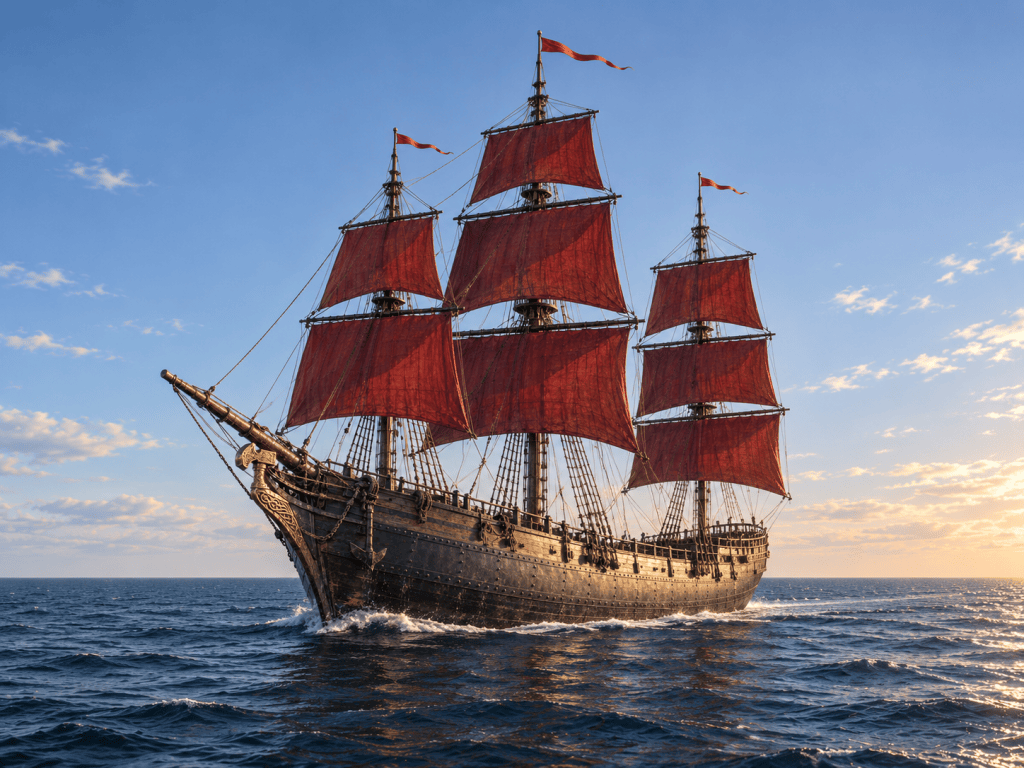
Picture a fantasy book cover: a red-sailed ship crossing an open sea. Before we even open the book, it promises distant shores, dangerous journeys, unfamiliar maps. It feels epic before we know where the ship is going.
But does every epic fantasy need a sea?
The sea can do many things for a story. It can separate people and cultures, make travel dangerous, create routes for trade or invasion, or carry characters towards places they barely understand. But a striking setting earns its place through what it makes possible—not simply because it looks right on a map.
In Ursula K. Le Guin’s Earthsea, the sea is part of the world’s basic structure. Earthsea is an archipelago, so travel between islands shapes how people encounter one another and how the world is imagined. The ocean is not scenery around the story; it is the space that connects its scattered lands.
Robin Hobb’s Liveship Traders makes the sea central in another way. Ships, trade, and the people whose lives depend on them drive the story. The liveships themselves—magical vessels carved from wizardwood—are bound to the people who sail them. Here, the sea is not just a route from one plot point to another. It helps create the story’s relationships, conflicts, and powers.
In C. S. Lewis’s The Voyage of the Dawn Treader, the voyage gives the adventure its shape. The characters sail into unfamiliar waters, and each new stretch of sea brings the possibility of a different encounter. The journey is the structure of the story: without it, this would be a very different book.
Tolkien offers a useful contrast. The sea matters to the wider history and mythology of Middle-earth, especially in the story of Númenor. But the central journey of The Lord of the Rings is not a sea voyage. A fantasy world can have oceans, islands, and a deep maritime history without making the sea the main stage of every story told within it.
That distinction can help when we’re choosing a setting for our own stories. Instead of asking only, “Wouldn’t a sea voyage be exciting?”, we can ask: What does the sea make possible in this story—and what would change if it weren’t there?
If removing the sea also removes a danger, a separation, a hard choice, or the only way forward, then it is doing real work. If the story unfolds exactly the same without it, perhaps the sea is only decoration. That doesn’t mean every setting must constantly create danger. It does mean the place should affect what characters can do, what they can’t do, and what their choices cost.
Epic fantasy doesn’t need a sea any more than it needs a desert, a mountain range, or a map covered in borders. It needs settings that matter to the story being told. Sometimes that means an ocean crossed by a ship. Sometimes the most important journey never touches the shore.
So, if you’re building a fantasy world, try asking: What does this setting make possible in my story—and what would change if it were somewhere else?


Leave a Reply