
Once dragons became characters rather than obstacles, another possibility opened up. The hero no longer had to find a dragon simply to fight it.
They could meet one. Trust one. And, perhaps most importantly, be chosen by one.
For a generation of Young Adult readers, Christopher Paolini’s Eragon is one of the clearest examples. Eragon begins as a fifteen-year-old farm boy. Then Saphira enters his life, and almost everything he understands about himself changes with her.
That is also where dragons and Young Adult fantasy fit together remarkably well.
Then came the dragon rider
Eragon becomes a Dragon Rider and is pulled into a world of magic, politics, war and responsibility far larger than anything he knew before.
YA fantasy so often asks the same basic questions. Who am I? What am I capable of? Where do I belong? What happens when people suddenly expect something from me? What do I do with power I did not have yesterday?
A dragon can embody all of those questions at once. Finding one can open the door to another world. Being chosen by one can transform a character’s identity. Riding one gives power, but that power immediately creates responsibility. And the relationship itself can grow alongside the protagonist.
That makes the dragon particularly suited to coming-of-age stories. The young protagonist isn’t simply acquiring a magical animal. Their world has become larger, and now they have to become large enough to live in it.
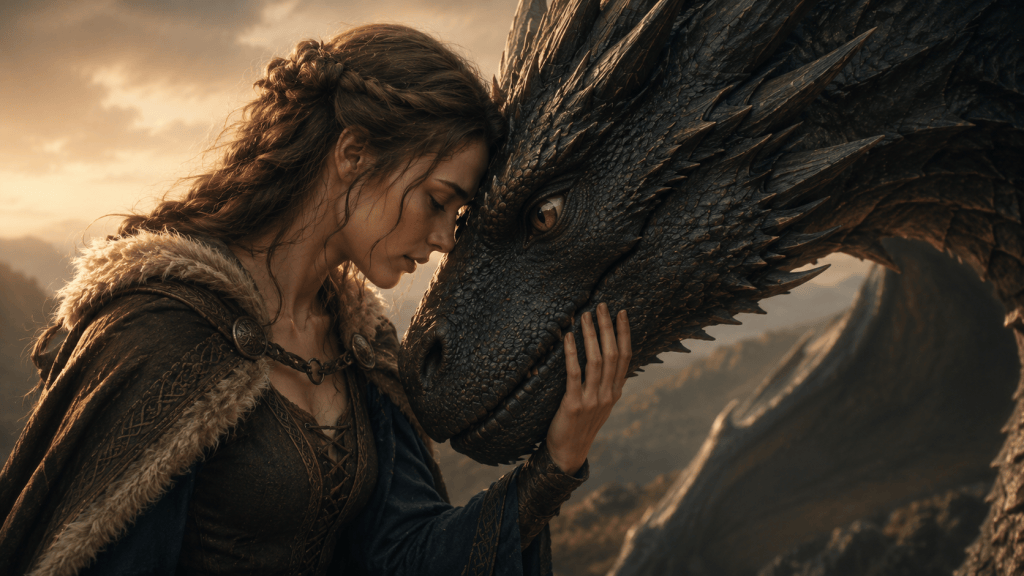
Perhaps the real fantasy is being chosen
There is another reason the bond between human and dragon works so well: dragons don’t need us. At least, the interesting ones don’t.
They are enormous. They can fly. They may breathe fire. They may live for centuries. In many stories, they are considerably stronger, older or more knowledgeable than the human standing beside them. That makes their choice unusually powerful.
A dog loving you is wonderful. A horse trusting you can be profound. But when a creature capable of burning down a city looks at one particular human being and chooses them, that carries a different kind of narrative weight.
It is power choosing connection.
Underneath all the scales, wings and fire, that is a remarkably human fantasy: to be seen, to be chosen and to be understood by something extraordinary.
Perhaps that is one reason dragons can feel emotionally accessible despite being physically about as far from us as a fantasy creature can get. We do not identify with their bodies. We identify with what they represent.
Freedom, power and loneliness
Dragons happen to embody an unusually rich collection of human desires and fears. They fly, so they can represent freedom. They are powerful, which gives them agency. They are difficult to control, which makes them symbols of independence. If they live for centuries, they can embody memory and loss. If they spend much of their lives alone, they can represent isolation.
They can hoard, desire, destroy, protect, grieve and rage. Depending on the story, a dragon can stand for greed, wisdom, violence, wilderness, political power, old age, loyalty or grief without ever ceasing to feel recognisably dragon-like.
Few fantasy creatures have that kind of range.
An elf already comes with expectations. So does a vampire. So does an orc. Dragons certainly have conventions too, but those conventions seem strangely elastic. A dragon can be a beast, a person, an army or someone’s closest friend, and somehow we accept all of them.
Perhaps that is why the dragon works so well in coming-of-age stories. It can represent freedom, power and a world much larger than the one the protagonist has known. But the bond adds something else. Being chosen by something extraordinary says: you matter to someone who does not need you to survive.
Underneath all the scales, wings and fire, that is an intensely human desire.
We do not need to imagine ourselves as dragons to understand them. We understand the wish to fly. The wish to be powerful enough to choose our own path. The fear of being alone. The burden of carrying memories other people have forgotten. And we understand the wish to be seen.
Maybe that is why some of the least human creatures in fantasy can create some of its most human relationships.


Leave a comment