When we choose fiction instead of nonfiction, most of us are looking for a way to step outside our everyday lives. The genre we reach for depends on what kind of experience we want. A crime novel offers suspense—and perhaps the satisfaction of identifying the murderer before the detective does. Science fiction lets us explore possible futures. Fantasy invites us into a world that has never existed.
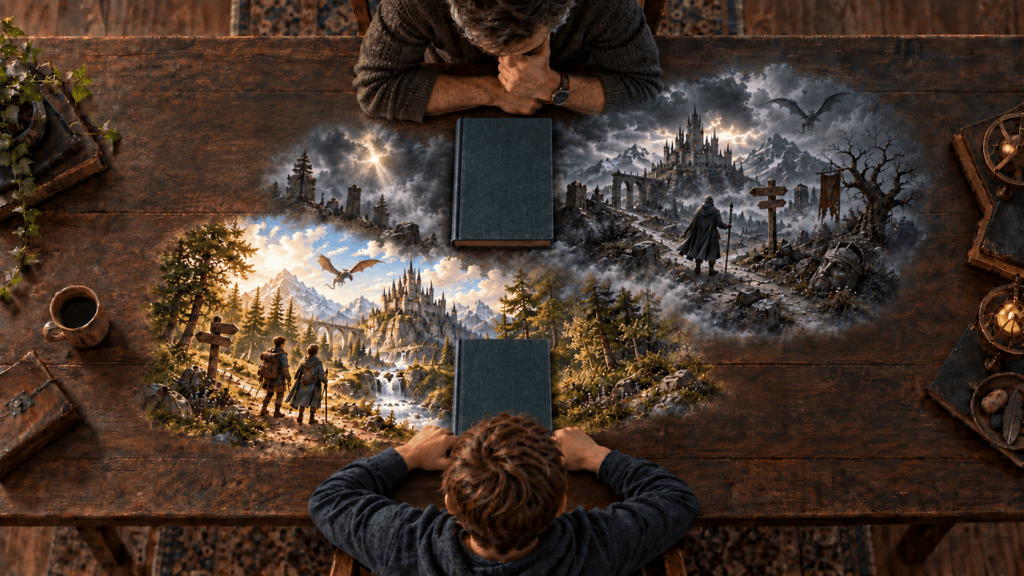
But can the same fantasy story mean one thing at thirteen and something entirely different at forty? Perhaps the story itself does not change. Perhaps only the reader does.
Reading at thirteen, reading at forty
At thirteen, we may see the quest. At forty, we may see what the quest costs.
Fantasy shares some of the fairy tale’s most familiar ingredients: magic, monsters, heroes and impossible quests. But it can use those elements to build far more complex stories—stories that explore grief, identity, power, prejudice, morality or loss. The imaginary world may draw us in, but what we find there is not necessarily childish.
A thirteen-year-old and a forty-year-old can read the same fantasy novel and both understand it. A younger reader might be swept away by the adventure, danger and friendships. An adult may recognise another layer beneath them, shaped by experiences the younger reader has not yet had.
That does not make one reading deeper or more valid than the other. We simply bring different memories, fears and expectations to the page.
Fantasy does not belong to childhood. It belongs to anyone willing to accept that reality can sometimes be seen more clearly through an invented world.
One genre, many kinds of escape
Nor does fantasy offer only one kind of reading experience. Rebecca Yarros’s Fourth Wing wraps romance and intimacy in dragons, magic and vivid worldbuilding. At the other end of the spectrum, Joe Abercrombie’s Before They Are Hanged is brutal, morally grey and unapologetically adult. Age suitability depends on the individual book, not on fantasy as a genre.
The imaginary setting is not always the true subject, either. Science-fiction author Zsolt Bugarszki says of Icarus, his novel about the beginnings of a human civilisation on Mars: “Icarus is not about rockets. It’s about people.” The same is often true of fantasy. It may show us dragons, enchanted swords and impossible lands, but beneath them, it is still about us.
This is also where the idea of escapism becomes more complicated. Personally, I read because I love entering a reality completely different from my own. During Covid, I could not read medical novels or watch hospital dramas. They were simply too close to the life around me. I did not need a lighter story; I needed distance. Stepping away from reality for a while does not mean refusing to face it. Sometimes distance is simply what allows us to breathe.
Does fantasy have to be useful? I do not think so. Pleasure, wonder and immersion are reason enough. If a story also offers comfort, empathy or a new way of seeing something, all the better—but it does not owe us a lesson.
So who reads fantasy: the adult or the child within? Maybe both. The child in us may still respond to magic and possibility, while the adult brings experience, memories and a different understanding of what is at stake.
But perhaps we do not need to explain it quite so neatly. We choose stories for countless reasons, and there is no age at which an imaginary world loses its power to absorb us. We may return to the same book at thirteen and at forty and find something entirely different waiting there.
Same book. Different eyes.


Leave a Reply